
EU–Ukraine Logistics: A Practical Guide for European Companies Entering the Ukrainian Market
In recent years, Ukraine has become one of the most discussed markets in Europe. Reconstruction programs, international investments, and large infrastructure projects are attractingthe attention of European manufacturers and service providers.
However, entering the Ukrainian market is not only a question of demand or productcompetitiveness. In practice, the organization of logistics and supply chains often becomes the keyfactor that determines whether a company succeeds or fails.
For many European companies, logistics between the EU and Ukraine still appears complex andunpredictable. Customs procedures, border crossings, infrastructure limitations, and regulatorydifferences create uncertainty for businesses that are used to operating within the single Europeanmarket.
At the same time, companies that understand how to organize their logistics properly gain a significant competitive advantage.
This guide explains the main logistical challenges between the EU and Ukraine and outlinespractical approaches that companies can use to build reliable supply chains.
Let’s look at this in more detail.
Why Logistics Is More Important Than Many Companies Expect
When European companies plan market expansion, logistics is often viewed as a technicalfunction that can be organized later — something that will simply work according to the samestandards they are used to in their home markets.
This is where the first mistake often occurs. Expectations do not always match reality. It isessential to clearly discuss expected results with contractors and partners. This simple approach hassaved us a significant amount of time and money.
In reality, logistics should be considered a strategic component of market entry.
In new markets, product availability, delivery speed, and supply reliability directly affect:
• distributors’ willingness to promote products
• customer trust
• service quality
• contract negotiations
Companies that rely on long and unpredictable supply chains often face delays, lost orders, anddissatisfied partners.
In contrast, businesses that build structured logistics models can offer a level of reliability thatmany competitors cannot provide.

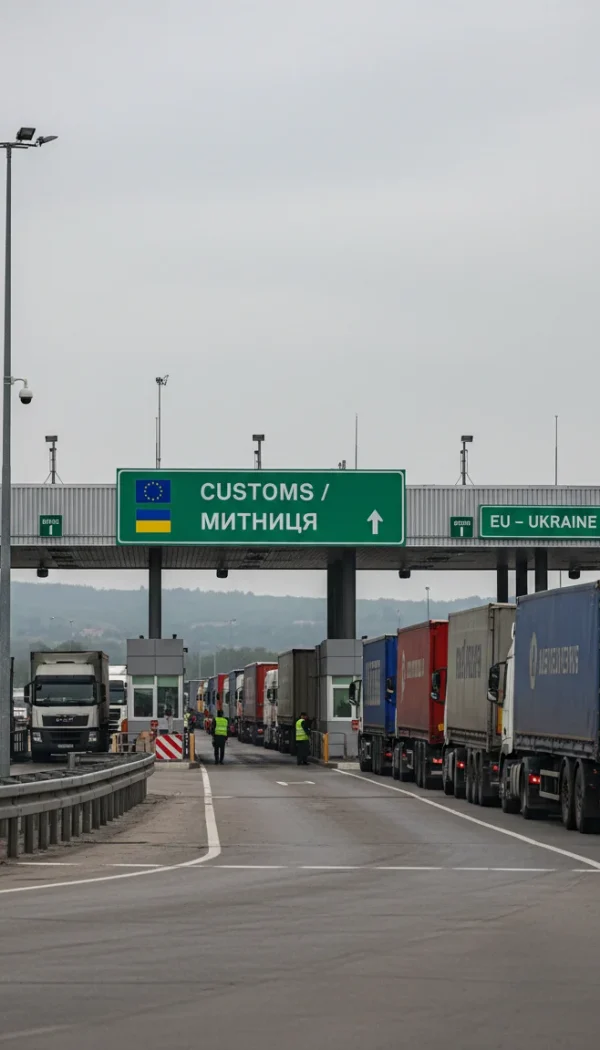
EU–Ukraine Logistics: Key Challenges
Customs Procedures and Clearance
Although Ukraine is closely integrated with the European economy, it is not part of the EU Customs Union.
This means that goods crossing the border must undergo customs procedures, including:
• border customs formalities
• customs clearance at destination — document verification and cargo inspection
• product classification
• customs tariffs
• non-tariff regulation — certification and compliance requirements
Border Customs Formalities
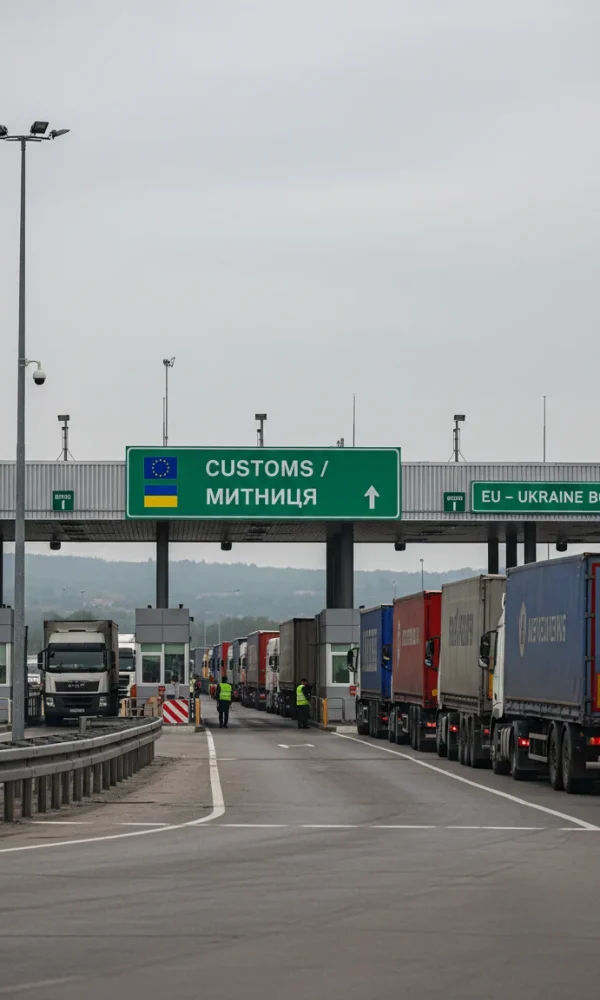
Before crossing the border, all necessary information must be submitted to customs in advance, and taxes (customs duty + VAT) must be paid.
In most cases, for products originating from the EU, the customs duty is 0%. However, manycompanies are surprised that VAT must be paid in advance. In Ukraine, this is a mandatoryrequirement.
Due to frequent documentation errors, cargo may be delayed at the border, leading to additionaldemurrage costs. As a result, shipments arrive late, with corresponding consequences for businessoperations.
For this reason, we strongly recommend preparing all documents in advance.
Companies that prepare documentation correctly and work with experienced logistics partnerscan significantly reduce delays.
Customs Clearance
Customs clearance is a broad and complex topic that is difficult to fully cover within a shortsection. In fact, it would require an entire separate report to explain in detail.
In short, all documents must be prepared in advance — at least in draft form.
In EU trade practice, commercial invoices are often issued at the moment of shipment. However, such invoices frequently do not meet the requirements for customs clearance.
Therefore, it is advisable to prepare draft documents and agree on them in advance with theimporter or customs broker.
The main documents required for customs clearance include:
• commercial invoice
• packing list (may be unnecessary if packing information is included in the invoice)
• transport document, such as a CMR for road transport
Additional documents may be required depending on the specific nature and complexity of thecargo.
It is important to remember that customs clearance is one of the most critical stages of thelogistics process. That is why it must be approached with great attention and prepared well inadvance.
To minimize risks, the key recommendation is to work with a professional customs broker whowill not leave you alone with a shipment stuck at customs at a critical moment.
We have nearly 20 years of experience in this field. During this time, we have faced manydifferent situations and handled cargo under various customs regimes. If you are unsure whom tocontact, feel free to reach out — we will be happy to help.
Product Classification
Product classification is part of the customs clearance process.
It is extremely important to determine the correct product code, as it directly affects the amountof customs payments and the list of required documents.
Sometimes even a single digit in the code can be critical: it may change the duty rate or requireadditional documentation, creating unexpected complications.
The product customs code (HS code, known in Ukraine as UKT ZED) is determined by thedeclarant — the person submitting the customs declaration. In most cases, this role is performed bya customs broker.
This stage should also be completed in advance.
A professional customs broker usually requests documents ahead of time to verify potentialrisks, including correct product classification and the customs value, which will be discussedbelow.
Customs Tariffs
Customs tariffs are taxes charged when goods are imported. In most cases, the duty rate for products manufactured in the EU is 0%.
However, to benefit from this rate, the exporter must provide supporting documentation — inparticular the EUR.1 certificate. This certificate is issued by customs authorities during the export procedure.
Certain challenges may arise even at this stage, which is why these issues should be planned inadvance.
In addition, Ukrainian customs authorities apply a system of indicative prices — one of the risk-control tools used to prevent fraud. For each product code, an indicative price per kilogram is defined.
If the declared price is lower than this reference value, the importer may need to prepare anextended package of documents to confirm the customs value of the goods — sometimes eventaking the matter to court.
We have encountered such situations many times and have successfully proven the real value ofgoods in approximately 85% of cases without litigation.
Nevertheless, this is complex and detailed work that requires preparation in advance.
Non-Tariff Regulation
Non-tariff regulation refers to compliance with Ukrainian legislation.
This includes the availability of necessary authorization documents such as: licenses, permits, certificates of conformity declarations of conformity
As with other customs-related issues, these requirements must be identified and prepared inadvance.
Our company cooperates with accredited certification bodies in Ukraine that conduct theseprocedures within their respective areas of competence.
Supply Chains and Border Infrastructure
Another important factor affecting logistics efficiency is border infrastructure and transitcountries.
Currently, most trade between the EU and Ukraine is carried out by road transport.
This means that border checkpoints can become overloaded during peak periods or in situationsinvolving political or economic conflicts.
For example, such situations occurred during border strikes in Poland and also due to transitrestrictions through Hungary, which were present at the time this article was written.
Alternative solutions such as rail transport or multimodal logistics models are graduallybecoming more important. These solutions help reduce dependence on road transport.
However, these systems are still not fully developed, partly due to railway infrastructurecharacteristics inherited from the Soviet era.
For companies planning long-term operations, analyzing multiple transport routes is animportant part of strategic supply chain planning.
Supply Chain Stability
One of the less obvious challenges is maintaining stable product availability.
If every order is shipped individually from Western Europe, delivery times may become too longfor many customers.
As a result, companies risk losing deals or reducing their competitiveness.
For this reason, many successful companies use regional logistics hubs or local warehousesolutions, allowing them to shorten delivery times and ensure stable product availability.
For example, we cooperate with two warehouse partners in Poland. This helps optimize logisticsand reduce supply risks.
Logistics Models That Work in Practice
European companies typically use several logistics models when operating in Ukraine.

Direct Export Model
In this model, goods are shipped directly from the manufacturer to customers or distributors.
Advantages:
• lower operational complexity
• no need for local infrastructure
Limitations:
• longer delivery times
• lower flexibility
• higher risk of supply disruptions
This model is usually suitable for companies with a limited number of shipments or thosesupplying specialized equipment.
Regional Distribution Hub
A more advanced model involves establishing a regional logistics hub in a neighboring EU country, such as Poland or Slovakia.
Advantages:
• shorter delivery times
• simplified logistics management
• better inventory control
This model allows companies to efficiently serve multiple Eastern European markets.
Local Warehouse Presence
For companies planning significant sales volumes, establishing local warehouse infrastructurecan significantly increase competitiveness.
Advantages:
• faster deliveries
• better customer support
• stronger relationships with distributors and partners
In many cases, local logistics infrastructure becomes a decisive factor when negotiating largecontracts.
The Strategic Importance of Early Logistics Planning
One of the most common mistakes companies make is treating logistics as a secondary issue.
In reality, logistics decisions directly influence:
• pricing strategy
• distributor network development
• service capabilities
• operational costs
Companies that design their logistics model at an early stage can scale their business much fasteronce demand begins to grow.
Conclusion
The Ukrainian market offers significant long-term opportunities for European companies.
However, success depends not only on product quality or pricing strategy.
Reliable logistics organization and well-structured supply chains often become the decisivefactors.
Companies that understand logistical challenges and build structured supply chains in advancewill be in a much stronger position as the market continues to grow.
As Ukraine continues its integration with European markets, the businesses best prepared forsuccess will be those that combine high-quality products with well-designed logistics strategies.
At the same time, the human factor should not be overlooked. Partners may view situationsdifferently, which is why it is important to align expectations in advance, clearly define tasks, andmaintain open communication.
This approach has saved us a significant amount of time and money.